
by Cassie Maas
How it Started
In the late 1970s I was living in an apartment in San Jose and selling advertising space for California Homes Magazine. One of my calls took me to Red Carpet Realtors in Capitola — the office sat at the end of 41st Avenue and Portola Drive — where I had a meeting with a realtor named Ralph. While I was there, Ralph introduced me to a man who happened to be in his office that day: Gary “Toro” Dresden. Toro took me to lunch. That was the beginning of a friendship that would eventually produce one of the first live traffic camera websites in California.
Toro had a remarkable family history. He and his brother Avery Gregory Dresden were the illegitimate sons of Avery Brundage — the fifth president of the International Olympic Committee, the only American ever to hold that position, and one of the most powerful and controversial figures in 20th-century sports. After Brundage died in Germany in May 1975 at the age of 87, Toro and his brother spent years pursuing a legal battle across three counties and two states for a share of his $19 million California estate. They each received a settlement of $162,500 in 1980. Toro had lived on the Peninsula for much of his life and was living in Woodside with his brother when we first met.
The Idea Takes Shape
By the mid-1990s, Toro and I were both living in Seascape. I was commuting to Palo Alto for work, which meant I was crossing the Santa Cruz Mountains on Highway 17 regularly. Anyone who has driven that road knows what it can be: narrow lanes, sharp curves, sudden fog at the summit, a punishing mix of commuters and trucks on a route that has earned its nickname “Killer 17” many times over. Every morning I made a judgment call with almost no information about what the road was actually like. Toro and I decided to change that.
The World Wide Web was still brand new. The idea of checking live traffic conditions on a website was something most people had never imagined. We saw the opportunity and we took it.
Building the First Camera at Redwood Estates
Toro scouted the highway and found the right spot: a property in Redwood Estates — a small, unincorporated community sitting right along Highway 17, about eight miles south of downtown Los Gatos — with a clear view of the stretch of road everyone called Satellite Curve. I went to the property owners and asked permission to install our equipment there. They agreed.
Toro built a structure on the property to house everything. I bought and paid for all the technology myself: a computer, a video camera, and a video capture card. We configured the system to automatically capture a still photograph of the highway every five minutes and upload it to the site. I owned the domain name and the equipment throughout. Simple by today’s standards — but in 1996, before smartphones, before Google Maps, before any of the traffic services people now take for granted, it was genuinely new. People driving Highway 17 every day could check our site before leaving home and see what the road actually looked like. Nobody else was doing that.
Hiway17.com officially launched on Thursday, August 29, 1996.
Toro Runs the Site — and the Recognition Begins
After the site launched, Toro took over the day-to-day management. I was paying the phone bill that kept the camera connection running, and I remained the owner of the domain and equipment throughout, but Toro was the one operating the site.
In the first six months after launch, the San Jose Mercury News wrote an article about Hiway17.com featuring Toro and Michael Norton who had invested some money into the site. The Mercury News was the heart of Silicon Valley journalism and a pioneer of online news — it had launched one of the country’s first newspaper websites in January 1995. Being featured in the Mercury News put Hiway17.com in front of an enormous Bay Area audience and established it as a serious resource, not just a local experiment.
Then on June 2, 1997, the San Francisco Chronicle mentioned the site in an article about Bob Glass, a Santa Cruz Mountains resident who used Hiway17.com to check highway conditions before his morning commute. Bob Glass was exactly the person we had built the site for — someone living in these mountains, looking out the window, and using our camera to make a decision about whether to get on that road. Seeing his name in the Chronicle was confirmation that what we had built was making a real difference in people’s daily lives.
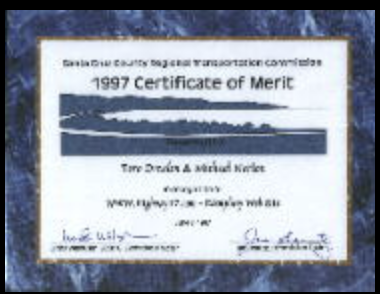
The site also received an Award of Merit – Exemplary Web Site from the Santa Cruz County Regional Transportation Commission. For a grassroots, privately funded website run by two people out of Seascape, that kind of institutional recognition was remarkable.
The Site Begins to Falter
Toro decided he wanted to try to make money from the site by asking visitors for donations. I supported that effort: I turned the phone bill over to him so he could take full ownership of the operating costs as he pursued that goal. But it never worked. The donations didn’t come in the way he had hoped, and once the site stopped looking like a path to income, Toro lost interest in maintaining it.
Around this time, both of us moved to the Peninsula. Toro relocated to Redwood City, close to his mother. I rented a home in San Carlos for myself and my daughter. Back in Redwood Estates, the residents who had been hosting our camera on their property moved away. With them gone, the camera came down. The original installation — the one that had started everything — was over. In a move to save the site, Toro moved the camera to the restaurant at the Summit with the totem poles. This site was problematic due to access issues created by the owners. I was unable to retrieve the cameras used at this site.
By July 3, 1998, Toro was posting appeals for donations on the site, citing financial difficulties. The writing was on the wall. On December 6, 1998, he posted a RIP image on Hiway17.com. The site was dead.
I Take It Back
I still owned the domain name and the equipment. In February 1999, living in San Carlos, I took back control of Hiway17.com and began using it as a personal blog. That was just the first step. On April 18, 1999, I relaunched it as a community site — its first true iteration as a resource for Santa Cruz Mountains residents rather than just a traffic camera or a personal page.
The site became most alive during crises: wildfires, severe winter storms, extended highway closures, the kind of emergencies that can cut mountain communities off from the world below. During those times people came to Hiway17.com to share what they knew, find out what their neighbors knew, and figure out what to do. I ran the site through various changes over the years, always trying to serve the community that had made it meaningful from the beginning.
Upgrading to the Summit: The AXIS PTZ Camera
As camera technology improved, I invested in a major upgrade. I purchased a $3,000 AXIS pan, tilt, and zoom camera — professional-grade equipment that could be remotely controlled to adjust direction and zoom in on different sections of the highway. It was a dramatic step up from our original fixed camera and gave viewers far more detail and flexibility when checking road conditions.
I installed the new camera on a pole at the top of the summit, at the site where a restaurant and real estate office sit on Santa Cruz Highway. I coordinated with the gentleman who was leasing the restaurant and he agreed to host the installation. Surf Net, a local internet service provider, supplied the high-speed internet access that made it possible to stream images live. The summit gave us commanding views of the highway in both directions. Now, it wasn’t just a view of the highway, it was used by the medevac helicopters airlifting victims injured on Highway 17 to Stanford Medical Center. It was the best the site had ever looked.
Sabotage
Then Joseph — the man leasing the restaurant at the summit — climbed the pole, opened the camera housing, taped off the wires inside, and put everything back together so it looked undisturbed.
I spent a long time in the rain trying to figure out what had gone wrong. I troubleshot every connection, worked through every technical explanation I could think of, and could not get the camera working again. It never occurred to me that someone had deliberately disabled it. I was looking for a malfunction, not an act of sabotage. It was the handyman who worked on the restaurant property — whose name I unfortunately no longer remember — who finally told me what had actually happened. When I understood what Joseph had done, I removed the camera from the summit while a Sheriff stood by. I have not replaced it since.
There is so much more to this part of the story that I have considered writing a book about it. Perhaps, one day I will.
Stepping Away — and Coming Back
My real estate career eventually demanded my full attention. I specialize in Santa Cruz Mountains properties, and the work I do for buyers and sellers out here requires the kind of deep local knowledge you only build over decades. Gradually, I let Hiway17.com go quiet. It sat idle for a number of years while I focused on that work.
But I never stopped thinking about it. In February 2026, I brought the site back — rebuilt, under the tagline “Your Community, Your Voice.” The Santa Cruz Mountains still need a place where neighbors can talk to each other, share information, and stay connected. That was true when Toro and I first set up that camera in Redwood Estates, and it is just as true today. It is time to bring it back.
What This Site Has Always Been
I look back on everything Hiway17.com has been — a traffic camera that a stranger named Bob Glass checked before his morning commute, a Caltrans recognition, a Mercury News feature, a Chronicle mention on the front page, a community hub during emergencies, a blog, a RIP page, a revival, and now a return to its roots.
It started with a lunch in Capitola. It grew into something that two major newspapers wrote about and a state transportation commission honored. It survived abandonment, sabotage, and years of silence. And now it is back, because the community that inspired it in the first place never went anywhere.
_________________________________________________________________________________________
Note: The San Jose Mercury News article from early 1997 and the San Francisco Chronicle article of June 2, 1997 have not yet been retrieved from paid archives. The Mercury News archive (1985–present) is available at mercurynews.newsbank.com and through San Jose Public Library’s free NewsBank access. The Chronicle archive is available at newspapers.com and through many public library systems for those wishing to read the original sources.
Leave a Reply