
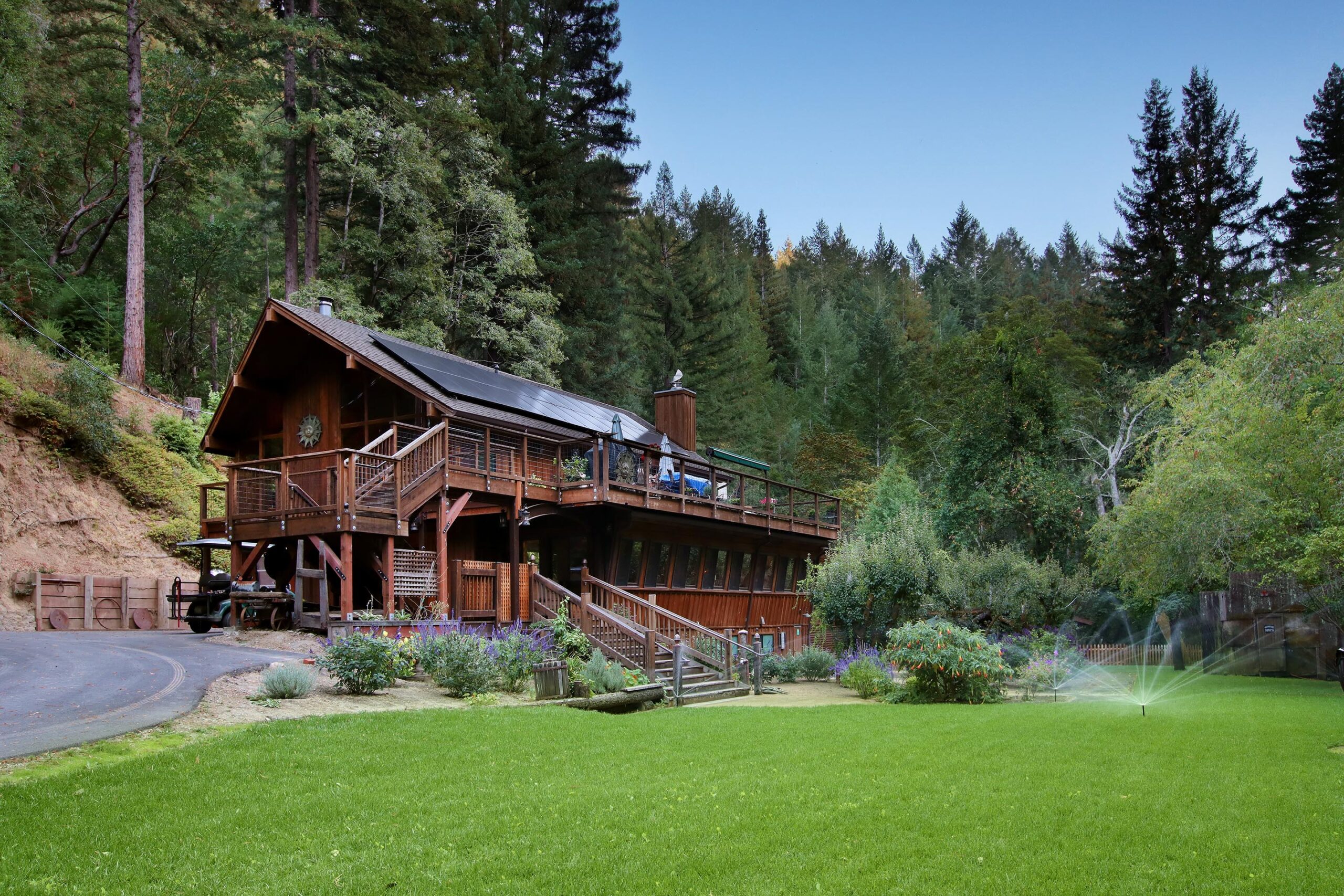
The Storied History of Laurel Mill Lodge
There is a particular kind of quiet that settles over the Santa Cruz Mountains in the early morning, when mist still clings to the redwood canopy and the creek runs cold and clear over smooth stones. It is the kind of quiet that makes you feel, just for a moment, that time is moving more slowly here than it does anywhere else. At Laurel Mill Lodge, tucked into a deep canyon along Redwood Lodge Road, that feeling has a lot of history behind it.
The 24-acre property sitting in Santa Cruz County with its Los Gatos mailing address has lived many lives over more than a century. It has been a roaring lumber operation, a foster home, a massage school, a nudist resort, and a beloved retreat center. Each chapter left something behind, and together they make Laurel Mill Lodge one of the most quietly extraordinary places in the mountains.
The Man Who Built the Mill
The story really begins with Frederic A. Hihn, a German immigrant who arrived in California during the Gold Rush with ambition and very little luck. Fires in San Francisco and floods in Sacramento wiped out his early ventures one after another, but Hihn kept going. He eventually made his way to Santa Cruz County, where he quietly accumulated vast stretches of mountain timberland over the years.
By the late 1890s, timber operations near Felton had exhausted the available redwood, and Hihn turned his attention to the untouched stands at the headwaters of Soquel Creek. Construction of the Laurel Mill began around 1900, with equipment hauled over from a previous Gold Gulch operation. The mill opened in November of that year and quickly became a major force in the region. A box mill was added shortly after, capable of turning out a thousand fruit boxes a day.
From 1899 to 1913, Laurel Mill was one of the Bay Area’s primary sources of lumber. When the 1906 earthquake and fire tore through San Francisco, it was redwood from this mill that helped rebuild large sections of the city. The scale of that contribution is hard to fully appreciate standing in the quiet canyon today.
Engineering a Mill in a Canyon
Building an industrial sawmill inside a steep mountain canyon required some creative problem-solving. Workers needed flat ground to stack and dry the lumber, but the canyon offered precious little of it. Their solution was a technique called rip-rap: crisscrossing layers of redwood trunks with rock and dirt fill, creating a raised platform solid enough to support buildings and operations. The creek was dammed to form a mill pond, where logs floated before being fed to a steam-powered bandsaw.
That rip-rap foundation is still there. If you know where to look, you can see its structure from the creek bed in certain spots, running from the front of the property where the old mill sat all the way back toward what is now the parking area. There is something quietly remarkable about standing on ground that was engineered by hand over a century ago and is still holding.
After the Timber Was Gone
By 1913, the surrounding forest had been largely harvested and the mill fell silent. For a few years, someone tried turning the old lumber yard into an orchard, but the canyon terrain had other ideas and the crops never really took hold. A pair of cabins were built from salvaged mill materials, and the property drifted into a quieter kind of life.
Then in 1943, a man named Alan Medlen purchased the site and opened a foster home for boys in the mountains. He built a swimming pool, laid out a campground, and expanded the old mess hall and site office. He added nine A-frame cabins, raised the main building onto a proper foundation, doubled the size of the dining hall, enlarged the kitchen, and added a second story. The structure that exists today as the main lodge carries the bones of all that work.
The Retreat Years
By the 1960s and into the 1970s, the property had become a retreat center and massage school called Getting In Touch. A hot tub was installed. A second swimming pool was added. The A-frame cabins were upgraded into what would become the deluxe cabins. The canyon that had once thundered with sawmill machinery was now a place where people came to slow down and pay attention to their bodies and their breath.
It was a fitting reinvention for the era and for the mountains. The Santa Cruz range has always attracted people looking for something different from city life, and the lodge, tucked away from roads and noise, offered exactly that.
Washed Out, Then Left Behind
The early 1980s brought the kind of winter storms that remind mountain residents who is really in charge. The bridge on Redwood Lodge Road washed out, and subsequent slide damage cut the property off from the outside world entirely. The retreat center closed. The road became impassable by conventional means.
What came next is one of the more colorful chapters in the lodge’s history. A woman named Nancy Penny leased the property and attempted to run it as a nudist recreation center. Members parked on the road above and scrambled down ropes and ladders to reach the facilities below. And apparently, many of them did so willingly, because the beauty of the place was simply that compelling. But even devotion to natural surroundings has its financial limits, and the venture eventually went bankrupt.
For years after that, the land sat empty. Scotch broom and blackberry moved in and reclaimed the grounds. The buildings sat quietly deteriorating. The creek kept running.
Coming Back to Life
In 1991, Esther Seehof and Bob Kundus purchased the property and began the long work of bringing it back. They reopened it as Laurel Mill Lodge, hosting retreats, workshops, reunions, weddings, and writers seeking the particular kind of focus that only true quiet can provide. The lodge developed a loyal following among people who knew that this kind of place, this deeply hidden, this genuinely still, was rare.
A new chapter began in 2017, when the property was purchased by Cliff Maas, a Soquel resident who described his approach to the land the way an artist talks about a canvas. He found the property overgrown and in need of significant care, and he set about renovating it with the kind of patient attention that old places reward. Among the results is a 1,200-square-foot conference room anchored by a massive redwood table with a hydraulic lift that can raise it toward the ceiling to open the space up, a detail that somehow feels perfectly suited to a building that has been adapted and reimagined so many times.
A Place That Holds Its History
There are properties in the Santa Cruz Mountains with interesting pasts, and then there is Laurel Mill Lodge, which seems to carry its entire history in its bones. The rip-rap under your feet was laid down by mill workers in 1900. You can watch the creek flow over the huge timbers into a pool of clear water. The conference room ceiling was once a mess hall roof. The redwood table was milled from trees that may well have grown within sight of where the table now sits.
It has survived the exhaustion of the forest around it, catastrophic storms, years of abandonment, and the kind of financial struggles that close most places for good. And yet here it still is, sitting in its canyon, the creek moving past the old mill pond site, the redwoods overhead doing what redwoods do. Time moves differently there. It always has.